EPBD directive · (EU) 2024/1275
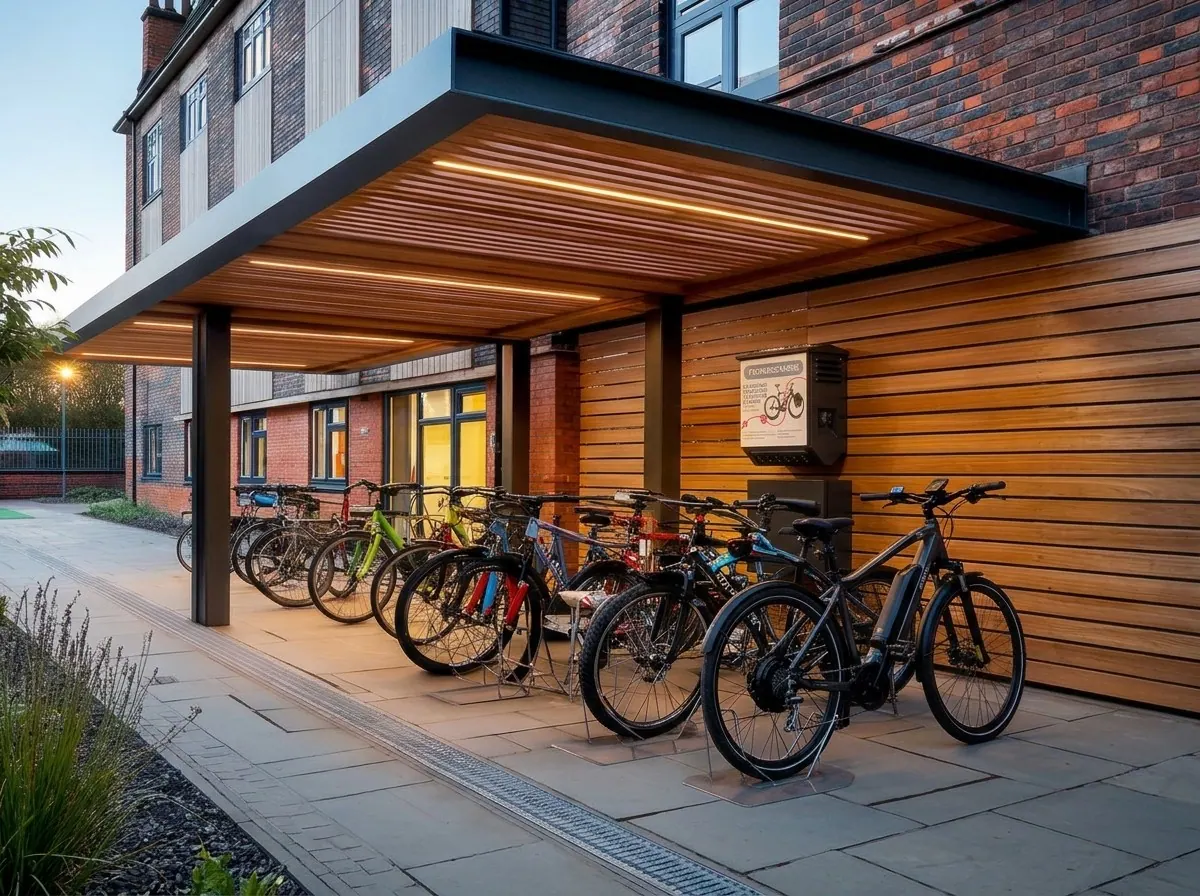
New rules for bike parking in buildings. Plan e-bike charging right away.
The EU Energy Performance of Buildings Directive requires member states to ensure bike parking at non-residential buildings with more than 20 car parking spaces by 1 January 2027. New buildings and major renovations face even broader requirements. What the directive says, how national rules apply and why charging belongs with bike parking.
In brief
Four questions building managers ask
Who does it apply to?
Non-residential buildings: offices, shops, schools, hospitals, hotels, production and warehouses. Existing ones if they have more than 20 car parking spaces (21 or more). New buildings and major renovations from 6 spaces. And new residential buildings.
How many bike spaces?
For non-residential buildings at least 15% of the average or 10% of the total user capacity of the building. For residential buildings 2 spaces per dwelling. The number of cars is only the trigger; bike spaces are counted from people.
By when?
Member states had to transpose the directive by 29 May 2026. For existing non-residential buildings the directive sets 1 January 2027. The specific obligations of owners are set by national law.
Does there have to be a charger?
The directive does not require a charger for every space. But for new buildings and major renovations it explicitly requires cable routes for later charging of e-bikes too.
Article 14
What exactly the directive requires
Three regimes depending on the type of building. For new buildings and renovations they apply only if the car park is inside or adjacent to the building and the renovation affects it.
| Building | Bike spaces | Charging preparation |
|---|---|---|
| Existing non-residential building with more than 20 car spaces | At least 15% of average or 10% of total user capacity, with room for larger bikes (cargo bikes, tricycles). Deadline 1 January 2027. | Recharging points or cabling for cars (1 per 10 spaces, or cabling for 50% of spaces). |
| New or majorly renovated non-residential building with more than 5 car spaces | Same requirement as above. | Cabling for 50% of spaces and ducting for the rest, so recharging points for cars, e-bikes and other light vehicles can be added. |
| New or majorly renovated residential building with more than 3 car spaces | At least 2 bike spaces per dwelling (in renovations as many as possible if 2 are not feasible). | Cabling and ducting, explicitly also for e-bikes. |
Article 14(1)(b) requires cabling and ducting so that recharging points for electric vehicles, e-bikes and other L-category vehicles can be installed later. E-bikes are not a marketing interpretation – the directive counts on charging them. Full text on EUR-Lex
Timeline
What happens when
- 28 May 2024The directive enters into forceThe recast EPBD (EU) 2024/1275.
- 29 May 2026Deadline for member statesMember states must have rules in force that transpose the directive.
- 1 January 2027Existing non-residential buildingsThe directive's deadline for bike parking at buildings with more than 20 car spaces.
- 1 January 2029Limited postponementOnly for buildings renovated in 2022–2024 under older rules. It is not a general postponement.
In your country
How it works in your country
The directive gives the task to the states. For a building owner, what matters is what the national law has taken over.
What the directive sets
- Minimum bike parking for new buildings and major renovations of non-residential buildings: 15% / 10% of capacity.
- 2 bike spaces per dwelling for new residential buildings and major renovations.
- Bike parking at existing non-residential buildings with more than 20 car spaces by 1 January 2027.
What national law decides
- How and when existing buildings must add bike spaces – states transpose at a different pace.
- Penalties. There is no uniform European fine for a missing bike rack.
- How user capacity and the link between car park and building are assessed for a specific property.
Each state transposes the directive in its own way and at its own pace. Germany, for example, is amending its law on e-mobility infrastructure in buildings (GEIG) with effect from 1 January 2027. The overview of national measures on EUR-Lex shows the status in each country.
Why charging
The new spaces will mainly be used by e-bikes
In Austria and Germany more than half of the bikes sold today are electric, in Czechia about one in three. And they are the more expensive ones: in the Netherlands e-bikes made up 49% of units sold but 73% of revenue.
- Austria57%
- Germany52.7%
- Netherlands49%
- Switzerland41.3%
- Czechia35% *
- France27.6%
- Spain21.5%
- Italy19.6%
- United Kingdom8.8%
- Otherwise batteries get charged in offices. Where there is nowhere to charge at the racks, people carry batteries to their desks and homes. That is exactly what firefighters and insurers want to reduce.
- Power is easiest to plan during construction. That is why the directive wants cable routes prepared in new buildings. If you plan the supply for charging together with the bike spaces, you avoid building work later.
- Employees, tenants and guests appreciate it. People commute further and more often by e-bike. Charging at work or at home is a benefit they actually use.
- One place for every bike. Different brands have different connectors. A station with cables for the main systems replaces dozens of individual chargers.
Indicative calculation
How many spaces and stations you will need
Enter the capacity of the building. The result is the minimum under the directive, not a recommendation for your operation.
- Minimum bike spaces
- 20
- Of which e-bikes
- 10
- Powerbox stations (8 bikes at once)
- 2
Indicative calculation under Article 14 of the directive. How user capacity is determined for a specific building and what exactly applies is set by national law.
EU recommendations
What good bike parking looks like
The European Commission's Expert Group on Urban Mobility recommends charging on top of the mandatory minimum. These are not extra obligations but practice that works.
Bike spaces
- Easy, ideally step-free access
- Near building entrances, not in the far corner of the garage
- Weather protection and secure locking
- Room for cargo bikes, tricycles and trailers
Charging
- A reasonable number of e-bike charging spaces
- Lockable lockers with sockets for batteries and gear
- A separate protected circuit with room to expand
- Charging placement assessed with the fire safety design
Source: Increasing the positive impact of parking policies, Expert Group on Urban Mobility, European Commission. Article 14(10) of the directive also requires the Commission to issue guidance on fire safety in car parks.
For planners
What to include in the design
Capacity and operation
- Number of spaces under the applicable rules and actual occupancy
- Manoeuvring space for heavier and larger bikes
- Rules of use, access and fault handling
Electrical and safety
- Power, simultaneous charging, protection
- A 30 mA RCD and central shut-off
- A cable route with spare capacity for more stations
FAQ
What building managers ask
Do we have to build a bike room by 1 January 2027?
The directive talks about bike parking spaces, not an enclosed bike room or a specific type of rack. The 1 January 2027 deadline applies to existing non-residential buildings with more than 20 car spaces, and it is an obligation of the member states. What owners must do and by when is set by national law – follow how your country transposes it.
Is a charger enough instead of racks?
No. Bike spaces and charging preparation are two separate things in the directive. Charging is an addition that turns bike parking into a place where e-bikes can be charged safely too.
Is there a fine for missing racks?
The directive sets no uniform fine; penalties are set by national law. Check the rules in your country.
How is the number of bike spaces calculated?
At least 15% of the average or 10% of the total user capacity of the building. A building for 500 people therefore needs at least 50 spaces. The number of cars in the car park only decides whether the rule applies.
How many e-bikes does one station charge?
Up to 8 at once: 6 DC outputs for Powerbox cables (five at 4 A and one fast output at 10 A) and 2 AC sockets for original chargers. With 50 bike spaces and a third of them e-bikes, that is 2–3 stations, depending on how many bikes charge at the same time.
Does it apply in every country?
The directive applies throughout the EU, but each state transposes it in its own way, with different deadlines, exemptions and penalties. Always check the national rules.
Sources
Where our information comes from
Legislation and recommendations
E-bike sales data
As of October 2026. This page is an information overview, not legal advice.
Consultation
We will plan bike parking with charging
Send us a few details about the building. We will calculate the spaces, propose station locations and supply documents for the planner.
Helena Gloryová, sales manager
sales@powerbox.one
+420 777 797 009